


Stationary Concrete Pump
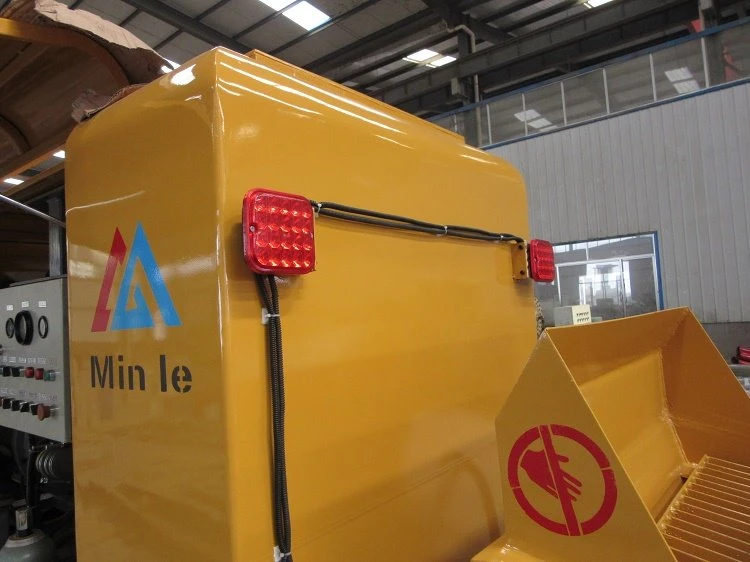
Brake Lights Equipped Towed Concrete Pump, we designed this new type according to client’s request, Towed Concrete Pump that is concrete trailer pump, designed sturdy traction at the rear of the concrete pump, the traction we can make it according to your truck or vehicle, towed the concrete pump.
Description
Overview
MINLE Stationary Concrete Pump have greatly improved the life of transmission pistons by using new materials and conducting continuous exploration and tracking experiments. The service life of wear plates and cutting rings has been increased by more than 30%, which belongs to the advanced level in the industry. Secondly, our electronic control system is equipped with a programmable controller, and each machine has a wire remote control. What's more, we use a unique cushioning design for inversion. This design minimizes instantaneous peak pressures and ensures smooth pump operation. Finally, our products are cheap and high-quality, which is deeply loved by our customers.
We are committed to providing customers with all-round and precise services to meet their various needs. We provide a variety of products based on many years of experience in the production of Towed Concrete Pump. We continue to improve technological innovation products, always put product quality in the first place, and strive to improve product quality. We strive to bring customers newer, more creative and more valuable products, and strive to become a leading enterprise trusted and respected by the society. We take "specialization, industrialization and internationalization" as our development goal, and insist on providing users with healthy, safe and cost-effective products, technology and services.

Parameter:
|
Item(Small trailer concrete pump) |
Unit |
HBTS30-10-78R |
|
Max Theoretical Concrete Output |
m³/h |
30 |
|
Max. Pumping pressure |
Mpa |
10 |
|
Concrete slump |
mm |
180-230 |
|
Brake lights |
Available |
|
|
Aggregate Size |
mm |
≤30 |
|
Engine Power |
kw |
78 |
|
Main oil pump |
KAWASAKI |
|
|
Hydraulic valve |
BOLSEEN |
|
|
Hydraulic hose |
MANULI |
|
|
Main electric element |
SCHNEIDER |
|
|
PLC Control computer |
MITSUBISHI |
|
|
Concrete Cylinder Diameter |
mm |
160/1000 |
|
Hopper Capacity |
L |
400 |
|
Filling Height |
mm |
1400 |
|
Max Theoretical Conveying Distance (Horizontal /vertical Height) |
m |
400/80 |
|
Pipe Cleaning Mode |
|
Water Washing |
|
Dimension(transport) |
mm |
5150×1700×2150 |
|
Total Weight |
kg |
4300 |
How Does The Concrete Pump Work?
The working principle of the concrete pump is that one piston sucks liquid concrete from the hopper into the cylinder, while the other piston simultaneously pushes the concrete out of the discharge pipe. Each time the piston reaches the end, determine which cylinder opens the concrete hopper and which cylinder switches the valve that opens the discharge pipe, and then the process continues. The first cylinder is now unloading, and the second cylinder removes fresh concrete from the hopper.
The internal working principle of a double-cylinder hydraulic concrete pump is usually composed of two parallel cylinders. There are driving pistons inside the cylinder, which can move them back and forth in opposite directions. When one cylinder moves forward, the other cylinder moves backward. When one cylinder moves backward, the other cylinder moves forward. The first cylinder, also called the material tank, pulls the concrete out of the hopper. The second cylinder, the discharge cylinder, pushes the concrete from the pump to the desired position. The two pistons work together to alternately pull in and push out their volume of liquid concrete. The hydraulic flow produced by the continuous flow of concrete is the cause of the alternating back and forth of the two cylinders. This continuous flow is also important to prevent the solidification of liquid concrete.

Benefits of Concrete Pumping
Move Concrete Past Obstacles
Many construction sites are obstacle courses, with trash piles, lumber, equipment, vehicles, and people to work around. You can circumnavigate some obstacles with a mixer truck, skid steer, or wheelbarrow, but some are only possible to get around with a pump truck. And often, the pour needs to take place in tough spots. Footers are usually in ditches; sometimes, you must get concrete up high on a second floor or roof. A pump truck makes it easy to transport concrete wherever you need it, all without the back-breaking labor of carting it by hand.
Avoid The Time Crunch
If you've ever received your concrete too soon, you know the panic and pressure it can cause! No one wants to run around frantically trying to get all the drying concrete into place before it solidifies. It can be very stressful! Luckily, with the efficiency of a pump truck, it's easy to get all your concrete poured and finished before it solidifies.
Save Time
Time is money, and a pump truck helps you maximize your work time. Using a wheelbarrow to move your concrete to the corners and hard-to-reach spots takes considerable time and effort. With a pump truck, you can avoid that extra effort and efficiently complete the job.
Save Money On Labor And Equipment
In addition to saving time, pumping your concrete also saves money since a pump truck does the job of many employees. You will no longer need to haul your concrete everywhere in wheelbarrows! This saves you money on wages as well as carting equipment such as wheelbarrows and skid steers.
Pour With Precision
Sometimes a concrete mixer truck deposits all the concrete in the right spot, but often there's a corner or two it can't reach. Then you have to haul out the wheelbarrows. On the other hand, a pump truck can convey concrete to every corner, no matter how odd or inconveniently placed, with ease and precision. The operator can use their remote control to move the boom anywhere it needs to go.
Keep Trucks Out Of The Mud
Most construction sites get muddy and messy. Concrete trucks are massively heavy, and they can't drive on soft ground, or they will get stuck. Nobody wants to pay for a tow truck to come and pull out a stuck concrete mixer. A pump truck can stay on safe ground and pump concrete from afar with its specialized hoses or boom.
The Main Concrete Pump Components And Their Functions
Main Pump (Main Cylinder)
The main pump is the core hydraulic cylinder of the concrete pump, responsible for pushing and conveying concrete. It pushes concrete out of the pump through reciprocating motion, controlling the flow direction and volume of concrete.
Distribution Valve
The distribution valve is located in the hydraulic system of the concrete pump, controlling the flow direction and distribution of concrete. It opens or closes as needed to regulate concrete flow, ensuring concrete is delivered to the designated construction location.
Concrete Hopper
The concrete hopper is located at the top of the concrete pump, used to store concrete and supply it to the main pump. The hopper's capacity and design can accommodate various construction needs, continuously supplying concrete through conveyors or bucket elevators to the main pump.
Delivery Pipes And Joints
Delivery pipes and joints connect various concrete pump components, transporting concrete from the pump to the construction site. Typically made of wear-resistant and pressure-resistant materials such as alloy steel or high-density polyethylene, they ensure unobstructed concrete passage and adapt to different construction environments and requirements through various fittings and elbows.
Electric Motor Or Diesel Engine
The electric motor or diesel engine provides power for the concrete pump, driving the hydraulic system and other moving parts. The electric motor is usually mounted above the pump or connected through a transmission device to provide the required power and torque, ensuring the pumps normal operation.
Hydraulic System
The hydraulic system provides the required pressure and flow, driving the main pump and other hydraulic components. It includes hydraulic cylinders, reservoirs, pumps, and pipes, using hydraulic oil pressure and flow to propel concrete delivery.
Control Panel And Control System
The control panel and control system monitor and regulate the operation status of the concrete pump, including the hydraulic system, electrical system, etc. They consist of control panels, sensors, switches, and other components, ensuring the safe, stable, and efficient operation of the concrete pump.
Valves And Switches
Valves and switches control the operation status and functions of various concrete pump parts for sale, including hydraulic valves, inlet valves, outlet valves, etc. They ensure the coordinated operation of various concrete pump components to achieve the desired delivery effect.
Common Applications Of Concrete Pumps
Slab Building Foundation: The concrete slab is used as the foundation for the building without basement. The important thing is to have a solid foundation that does not allow water to enter, crack, or sag. The concrete pump works quickly and smoothly, and the concrete ends where it should be. In this way, the foundation will not be flawed.
Laying a Basement: For a building with a basement, the process of laying the foundation is more complicated. Concrete pumps such as boom pumps are critical, so no time delay errors may occur or part of the concrete can harden before it is prepared. The use of boom pumps on basement foundations helps to ensure that construction works can be completed on time.
Expressway Overpasses And Tunnels: Expressway overpasses must be made of durable reinforced concrete to support the tonnage of traffic passing through them every day. The road tunnel must also be strong enough not to collapse under the weight of the soil above it. Using a concrete pump can ensure that the work is done efficiently and effectively. Overpasses and tunnels also often involve some elevation work, and the use of concrete pumps, especially boom pumps used to increase lift, makes this work faster and easier.
Bridges And Dams: Bridges and dams must be large, strong and stable to support the weight of heavy vehicle traffic and strong water pressure. In particular, the boom pump has the advantages of lifting and extending, which can ensure that the concrete can be quickly pumped to the top of the high bridge or dam.
Underground Swimming Pool: The underground swimming pool has a concrete foundation, just like a basement. Concrete pumps, especially boom pumps, provide a special advantage for the construction of backyard swimming pools. No one wants a heavy truck to pass through the backyard, but the concrete pump can easily reach the top of the house from the street, pouring concrete, and have little impact on the yard.
Delivery for Towed Concrete Pump
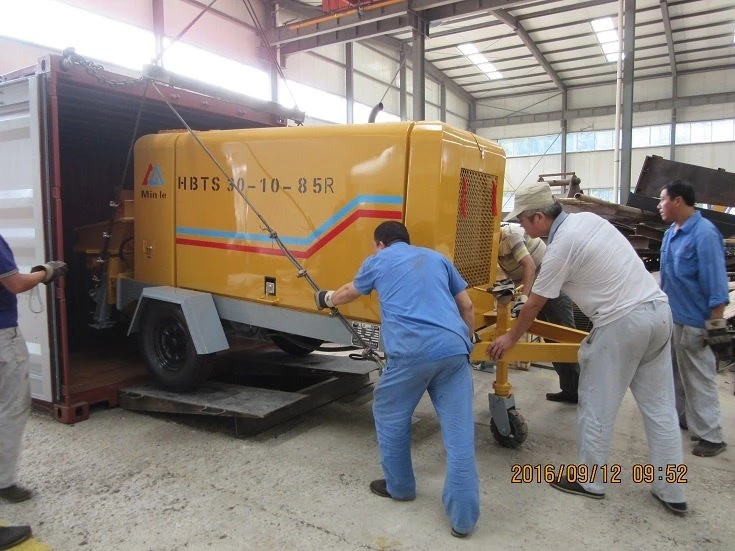
Since these concrete pumps are mounted on trailers, they can be easily transported to any job site using a tractor or a suitable vehicle.
Trailer mounted pumps are generally small in size are can be towed by a standard pickup truck. However, one needs to ensure that the vehicle should be powerful enough to pull the tow behind concrete pump.
The specification sheets for a pump will give the dimensions of the equipment as well as the towing weights.
For towing safety and convenience, it is always advisable to look for a pump that is mounted on a highway-rated trailer.
The highway-rated trailers are equipped with features such as an adjustable-height hitch, hydraulic surge brakes, durable fenders, stop/directional tail lights, and a heavy-duty frame with torsion bar suspension, making it safe during transport.

Steps To Setting Up A Towed Concrete Line Pump
Find A Level Surface
It is important for you to first find a level surface where you can set up your concrete line pump. You should also pick a spot where a mixing truck can back into the hopper. Once you have chosen a safe location, level, and area where you can easily store your components, it is time to assemble your concrete line pump.
Attach The Suction Hose And Chute
Take some time at this step to look over your pump and make sure it is completely ready for use. If there is damage done to any part, take the time here to fix it before moving on with the rest of the assembly. Attach the suction hose to the pump. Attach the chute to the hose using a small amount of machine oil or silicone.
Test The Line
Test by filling one of your containers with water and pouring it in as a check for any leaks that may have formed from assembly or from damage that was done before you received it.
Prepare For Using The Pump
After testing, prepare the pump for use. Check your concrete pump engine and oil levels. You have to check the "S" tube for any kind of obstructions and stretch out the hoses. Then hook the hoses up with the clamps. Use slurry to prime the concrete pump and stroke it a few times. It helps the hoses to be coated before pumping concrete.
Cleanup The Concrete Pump
Once you have finished using the pump, it's time to clean it up. You have to pour water into the hopper and start pumping again to clean the hoses. It will remove concrete stuck in the hoses. Then disconnect the hoses from the hopper.
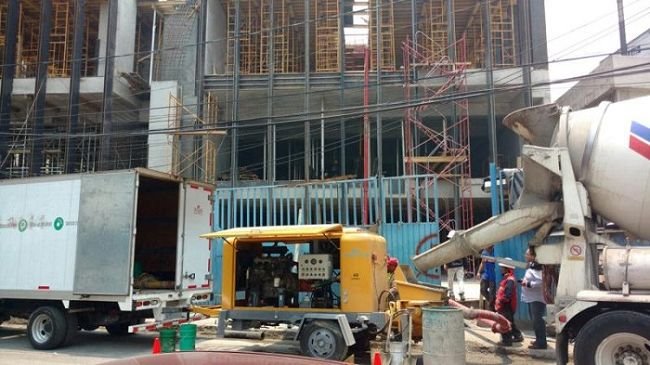
Construction Case:

How to Maintain a Concrete Pump
Greasing & Oiling
Lubrication is considered the most important aspect of regular or day-to-day maintenance on concrete pumps. Operators should always ensure that they grease the boom once a week and perform a visual check of the boom and pipework. Most concrete pumps are equipped with an auto-lube system that greases all sections that require lubrication automatically. Concrete pump operators should also check the water and oil levels in the wash box on a daily basis. Remember to inspect the vehicle's overall condition, including the tires and oil, as industrial use of a concrete pump can cause extreme wear to various sections of the vehicle.
Chassis
The chassis as we know has a significant impact on the pump truck's lifespan. This is the determinant of how long the pump truck will work in the end. The concrete pump truck's stability is also supported and maintained by the chassis. More importantly, the chassis serves as the power supply for the concrete pump truck's long-term and uninterrupted functioning. The chassis must be kept in good working order. When pouring, the engine and transmission were running even if the vehicle was not operating.
Engine
Through its connection with the transmission device and transmission system of the entire machine, the engine, which is the heart of the vehicle, provides driving and operating power for the concrete pump truck.
- Examine the engine's oil level and condition.
- Check the engine's coolant level and water temperature.
- Check the oil pressure in the engine.
Transmission System
The concrete pump's transmission system consists of a gearbox, transfer case, and transmission shaft, which, like the aorta in the human body, distributes power to the driving wheel and hydraulic pump on a continuous basis.
- Check the wear and pressure of your tires.
- Inspection of the electrical system (lighting, indicator lights, stop lights).
- Mirrors in the rear view mirrors are inspected.
- Examine all of the guidance lights.
- Check for oil and gas leaks, and tighten the fittings if there are any.
- Safety devices such as limit switches and safety locks are inspected.
- Check that any moving pieces (such as fixed outriggers and booms) are in a fixed position before moving the pump truck.
Hot Tags: Stationary Concrete Pump, China Stationary Concrete Pump manufacturers, suppliers, factory


